
with azbil
Trivia
Downforce

Downforce is the force exerted downward on an object by the flow of air and is primarily used in the design of vehicles that travel at high speeds. For example, F1 racing cars are designed to allow faster airflow underneath the car and slower airflow above it. This creates a pressure difference due to the difference in air speed, resulting in low pressure on the bottom surface and high pressure on the top surface. This phenomenon is based on Bernoulli's principle. The pressure difference generates downforce, intentionally creating a situation in which the vehicle is pressed firmly against the road surface and allowing the vehicle to run stably without losing speed.
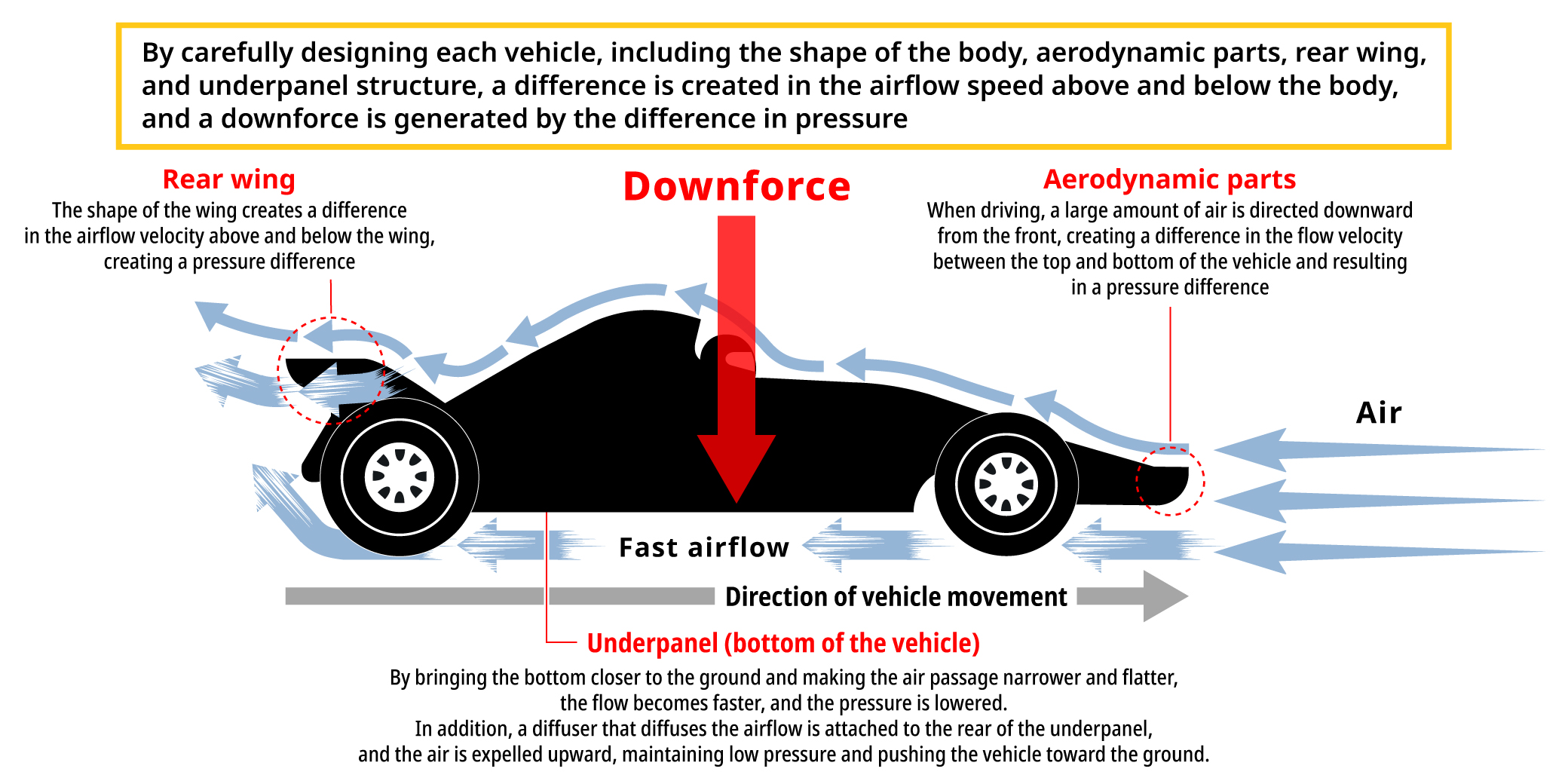
When a vehicle moves, the air flows around it, creating a pressure difference. In particular, the airflow changes depending on the design of the body shape and the wings of the car, generating downward force. Increasing the downforce provides the following benefits to the vehicle:
1. The contact pressure between the tire and the road surface increases, improving grip. This increases stability during cornering, allowing the driver to turn at higher speeds.
2. Downforce is generated when driving at high speeds, increasing stability when braking and enabling the car to stop in a shorter distance.
3. During acceleration, downforce increases the load on the rear wheels, preventing tire slip. This makes more efficient acceleration possible.
However, downforce does not occur without drawbacks. Creating downforce increases air resistance and road resistance, which can lead to reduced fuel efficiency and lower top speed. For this reason, racing car designers design car bodies while considering the balance between downforce and air resistance.
Racing cars and high-performance vehicles use a variety of techniques to adjust their downforce. For example, sports cars and high-performance vehicles are equipped with rear wings, whose angle and position change depending on the driving conditions. By installing these and various aerodynamic parts, such as front splitters and diffusers, it is possible to adjust the downforce according to the driving conditions and driver preferences. The suspension settings and the vehicle's center of gravity also affect the downforce.
Downforce is essential for improving automotive performance. In particular, in car racing, it is necessary to maximize the effect of downforce. Achieving proper downforce improves the handling and braking performance, enabling safe and efficient driving. As technology continues to evolve, further improvements in performance are expected by enhancing downforce control and optimization. To achieve this, measurement and control technologies that can accurately capture changes in airflow and pressure and optimally control them according to the driving conditions will become increasingly important.
- *This article was translated from the Japanese version of the article published on October 10, 2025.