
with azbil
Trivia
Inverter Control
Inverter control is a type of power conversion technology that uses an inverter device to vary voltage and frequency, and is primarily used to freely control the rotational speed and torque of a motor. It is used in a wide range of fields, including industrial machinery, home appliances, and transportation systems.
Inverter control basically consists of three processes. First, rectification is performed, converting alternating current (AC) into direct current (DC) via a converter. Diodes*1 and thyristors*2 are used for rectification. Next, since the rectified DC has waves, it is smoothed using a capacitor or other device. Finally, the smoothed DC is repeatedly turned on and off at high speed by the inverter circuit's transistors (such as IGBTs)*3, which reconverts it into AC of the desired frequency and voltage (inversion).
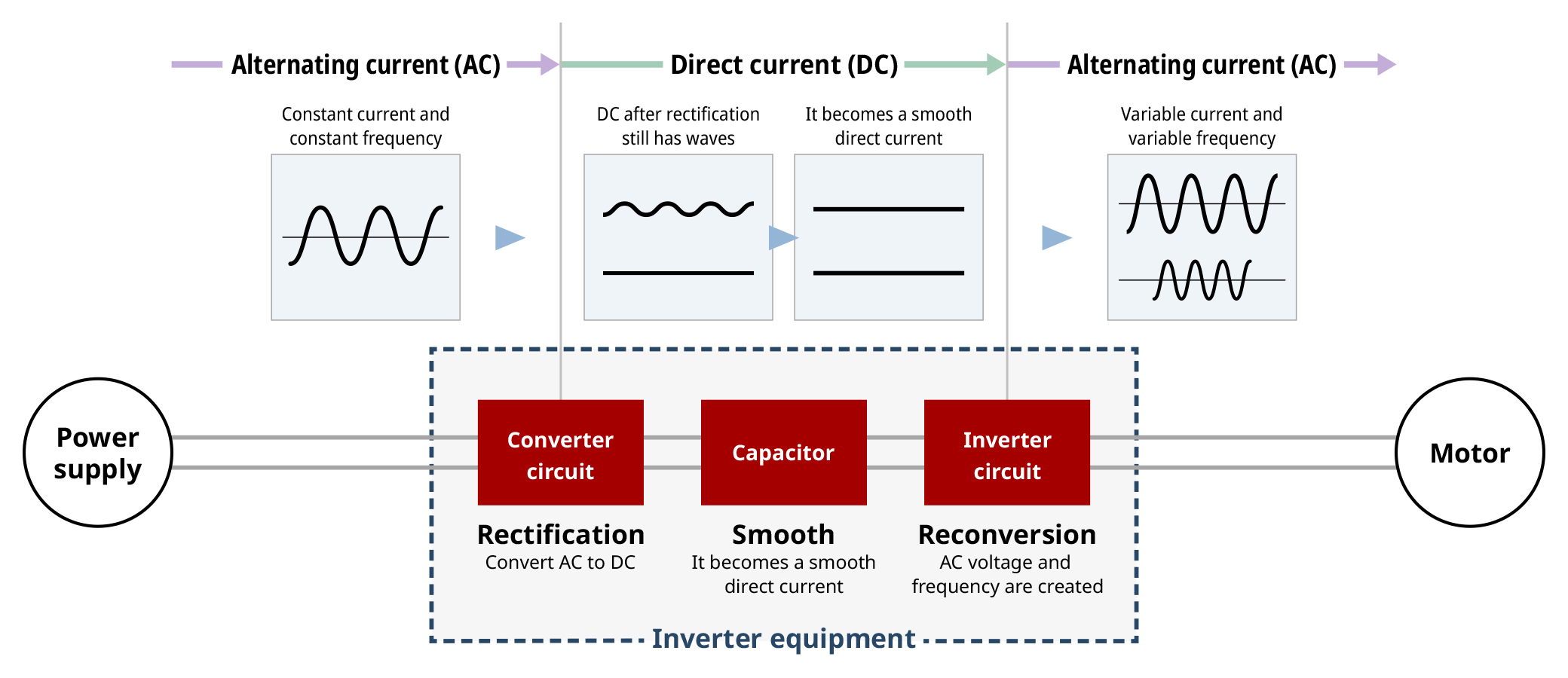
In this way, the key to controlling a motor is to create AC that can be adjusted to the desired frequency and voltage. This is because the rotational speed of the motor is proportional to the frequency of the AC supplied. In other words, by changing the frequency, the motor rotation speed can be controlled as desired, which provides the following three advantages.
-
1. Energy conservation
By controlling the motor's rotation speed according to the load on the equipment, it enables efficient operation without consuming excessive power. -
2. Flexible speed control
The motor speed can be smoothly adjusted, enabling precise control in production lines and conveying equipment. It also enables high-precision operation, such as adjusting the rotation speed in real time according to load fluctuations or keeping the rotation speed constant. -
3. Extending the life of the machine
It reduces the stress caused by sudden starts and stops, which reduces the strain on the motor and the machine as a whole and is expected to extend their lifespan.
Inverter-driven motors are used in factories to control the speed of conveyors and other transport equipment, pumps, fans, etc.; in homes, in electrical appliances such as air conditioners, refrigerators, and washing machines; and in the transportation sector, in train, electric vehicle, and elevator systems. Furthermore, it is essential for renewable energy systems such as solar and wind power generation.
Conventional inverter control controls the rotation speed by proportionally changing the motor frequency and voltage, but there have been challenges such as low torque control precision and slow response. Vector control*4 was developed to improve this, and is characterized by its ability to precisely control torque. In addition, advanced inverter control technologies such as sensorless control have recently emerged, which estimates the motor's state through calculations instead of using sensors to accurately determine rotational speed or position, leading to greater precision and efficiency in operation.
- *1: Diode
A semiconductor component that allows current to flow in only one direction, preventing reverse current. - *2: Thyristor
A semiconductor element used primarily as an on/off switch for alternating current (AC) and direct current (DC) circuits. - *3: Transistor (IGBT)
A transistor is a general term for a semiconductor element that controls current, and IGBT is one type of transistor. They can easily handle large currents and are widely used as switches in inverter circuits. - *4: Vector control
A method of improving motor inverter control. The magnetic field inside the motor is coordinate-transformed and divided into the "d-axis (magnetic flux direction)" and "q-axis (torque direction)," and each current component is controlled independently, thereby improving torque response and efficiency.
- *This article is a translation of the Japanese version published on January 9, 2026.