
with azbil
Trivia
Remote work

With diverse working styles now well established, remote work—doing your job outside the office at home, in shared offices, or a cafe—has become common. At the same time, cyberattacks targeting the ICT*1 environment that supports remote work are occurring with increasing frequency.
In many companies, employees can access their internal systems from external networks, such as their home internet connections, via VPN*2. This allows them to work in an environment that is no different from being in the office. Attackers target the ICT environments that are essential for remote work. If such an attack is successful, there is a risk that your internal systems may be infected with malware—malicious software designed to harm computers, servers, or networks—or be exposed to unauthorized access.
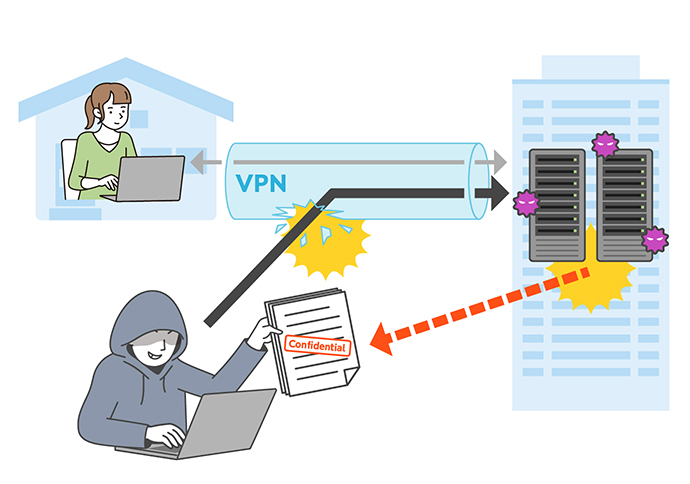
There are three typical attack methods:
-
1. Exploiting vulnerabilities in remote work products
Attackers exploit vulnerabilities and configuration errors in remote work devices and VPN equipment to gain unauthorized access to internal systems. -
2. Unauthorized use of account information
By carrying out brute-force attacks (a decryption method that tries every possible combination) or abusing previously leaked account information, attackers gain unauthorized access to internal systems via VPN equipment or remote desktop*3. -
3. Attacks targeting remote work devices
Attackers embed malware in emails to infect devices and steal information. Then, they misuse the stolen information to gain unauthorized access via VPN.
To defend against such attacks, measures are required at both the organizational and individual levels. An important measure for organizations is to strengthen the security of their remote work environment. For example, measures include “zero trust,” which eliminates the boundaries between external and internal networks and performs strict access verification on all information, and “thin client,” which centrally manages data on a server rather than storing it on the device. Using equipment that is no longer supported or cannot be maintained should be avoided.
On the other hand, ensuring environmental safety also depends on the individual measures taken by users. The basics include everyday measures such as updating software, using security software, setting strong passwords, and reviewing network device settings.
Both organizations and users must adhere to remote work regulations and continually work to improve their information literacy and security awareness, which directly contributes to reducing risks.
-
*1: Information and Communication Technology (ICT)
Information and communication technology. A general term that combines “technology for handling information” with “technology for connecting via communication.” -
*2: Virtual Private Network (VPN)
A virtual dedicated line is created on the Internet, and the communication content is encrypted. A security technology that allows secure external connections to internal systems to prevent information leaks and tampering. -
*3: Remote Desktop
Technology that allows you to access PCs and servers in different locations and remotely control them from a local device
Reference:
Information-technology Promotion Agency, Japan (IPA) Information-technology Security Center “10 Major Security Threats” (in Japanese)
- *This article is a translation of the Japanese version published on March 10, 2026.
 Related information