
with azbil
Trivia
- NEW
Thermostat

A thermostat is a device that detects the ambient temperature and automatically controls heating or cooling to maintain a preset temperature setpoint. Its role is to maintain a constant temperature. It is used in our daily lives in household electrical appliances (air conditioners, refrigerators, water heaters, etc.) and in building air conditioning systems such as those found in offices.
Thermostats have long played an important role in the pharmaceutical industry and in the semiconductor and electronics manufacturing industries. Proper temperature management affects product performance and production efficiency in these fields, which means that stricter temperature control has become necessary in recent years.
Thermostats detect temperature changes as physical or electrical changes and use those changes to switch something ON or OFF.
One of the most common methods that utilizes physical changes and that has been used for a long time is something called a bimetallic strip. A bimetallic strip is made by bonding together two metals with different thermal expansion coefficients. When the temperature rises, both metals expand, but the metal with the higher thermal expansion coefficient expands more and bends towards the metal with the lower thermal expansion coefficient.
The change in the curvature of this bimetallic strip causes the contacts that serve as the pathway for electric current to open and close (OFF/ON). The system is designed so that the current is cut off when a preset temperature setpoint is reached, and then restored when the temperature drops below that setpoint.
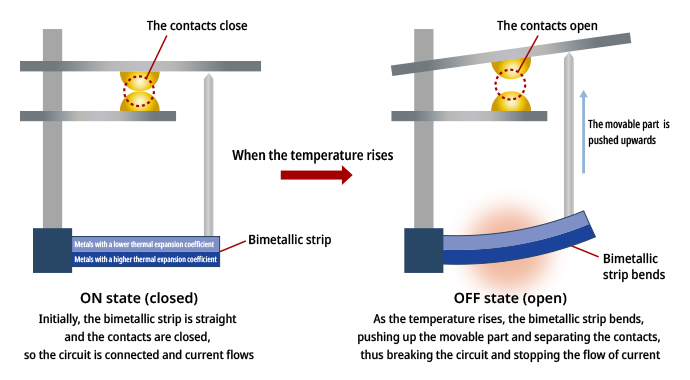
Common bimetallic materials include iron-nickel-chromium alloys and copper alloys for the high-expansion side, and Invar (36% nickel, 64% iron) and nickel-based alloys for the low-expansion side. There are also thermostats that utilize the expansion of liquids or gases instead of metals. While these all have the advantage of being able to control temperature with a simple structure, they struggle in applications that require more precise temperature control.
For applications in which precise control is needed, electronic thermostats that utilize electrical changes are used. Electronic thermostats directly measure temperature using temperature sensors such as thermistors, compare that to a preset temperature setpoint, and control heating and cooling via relays and semiconductor switches using electronic circuits and microcontrollers.
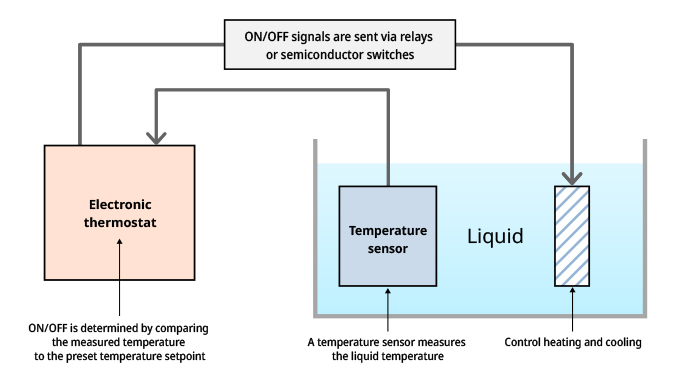
This method allows for precise temperature control, enabling advanced functions such as hysteresis control*1, timer control, and energy-saving control. Some devices offer PID control*2 and more precise temperature control in addition to simple ON/OFF control. Furthermore, some devices have features such as alarm functions, while others offer internet connectivity for remote control.
This is how thermostats play the role of maintaining a constant temperature in various ways, making use of simple physical phenomena or sophisticated electronic control, depending on the application. Thermostats work behind the scenes as an essential technology that supports our comfort, safety, and even energy efficiency.
-
*1: Hysteresis control
This control method operates based on the system's previous state (whether it was ON or OFF) to prevent the ON and OFF states from switching at the same value. -
*2: PID control
A basic feedback control method that controls input values using three elements: the deviation between the output value and the target value, the integral and the derivative of that deviation.
- *This article was translated from the Japanese version of the article published on April 8, 2026.