
with azbil
azbil Stats
CO2 emissions reduction at customers’ sites
Aiming to reduce 3.4 million metric tons of CO2 at customers’ sites by 2030
Guided by its philosophy of “human-centered automation,” the azbil Group promotes contributions “in series” to a sustainable society. We have formulated the Essential Goals of the azbil Group for SDGs, which set four basic goals to be achieved by 2030, along with related targets.
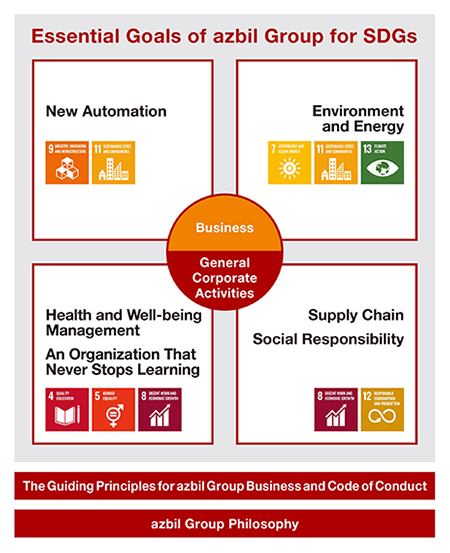
In the “Environment and Energy” area of the basic goals, we recognize that responding to climate change is a priority and have set solving energy issues toward a decarbonized society as one of our targets.
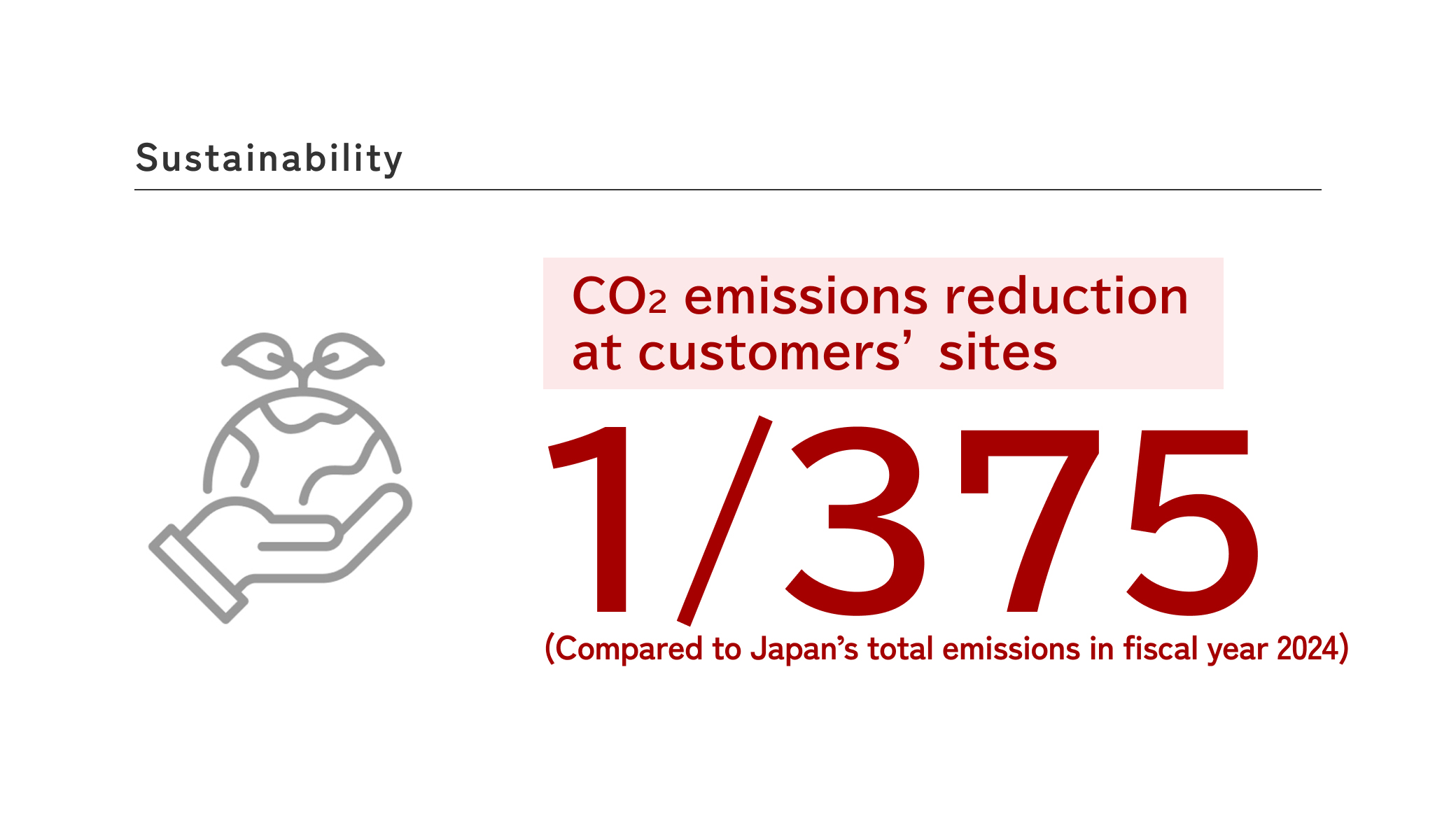
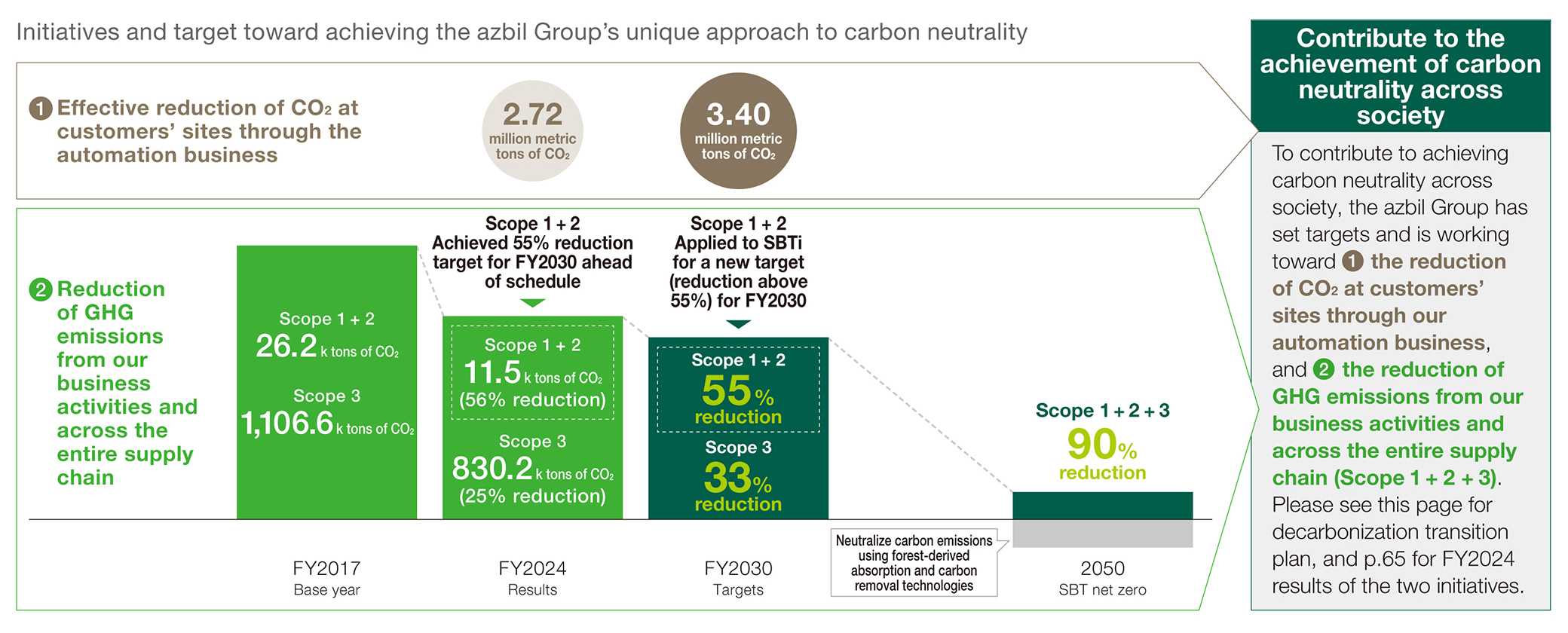
Toward the realization of a decarbonized society, the azbil Group is working to reduce CO2 emissions at customer sites through its business activities of providing products, services, and solutions, and has set a goal of reducing CO2 emissions at customer sites by 3.4 million metric tons*1*2 by fiscal year 2030. In fiscal year 2024, the CO2 reduction effect at customer sites was 2.72 million metric tons per year, which is equivalent to approximately 1/375 of Japan’s annual CO2 emissions of approximately 1.02 billion metric tons*3.
Aiming to achieve substantially zero GHG emissions from our business activities
Regarding our own business activities, in 2020, we formulated the “2050 Long-Term Vision for Reducing Greenhouse Gas Emissions,” which aims to achieve virtually zero GHG*6 emissions (Scopes*7 1 + 2) by 2050, and we are promoting energy conservation and the use of renewable energy. Furthermore, we are creating and providing environmentally friendly products and services to help address environmental issues in society by realizing “integrated environmental corporate management,” which integrates environmental issues with business challenges.
- *1: To quantitatively evaluate contributions to reducing environmental impact, the effects were categorized into three groups: (1) effects of automation, (2) effects of energy management, and (3) effects of maintenance and services. The reduction effect was estimated as the difference compared to a scenario in which azbil Group’s products, services, and solutions were not adopted at the customer’s site. Please note that the global reduction effect is based in part on our own unique approach.
- *2: The method of estimation is reviewed by an independent external party.
-
*3: Approximately 1.02 billion metric tons per year
Greenhouse gas emissions and removals in fiscal year 2023 (summary) (in Japanese)
Decarbonized Society Promotion Office at the Ministry of the Environment and the Greenhouse Gas Inventory Office of Japan at the National Institute for Environmental Studies -
*4: Science Based Targets initiative (SBTi)
An organization established in 2015 by the CDP, a consortium of institutional investors promoting disclosure on climate change actions, the World Resources Institute, the World Wide Fund for Nature, and the United Nations Global Compact, to achieve science-based targets for greenhouse gas emission reduction. It is an international initiative that certifies whether a company’s CO2 emission reduction goals are consistent with scientific evidence. -
*5: Science Based Targets (SBT)
A greenhouse gas emission reduction target set by a company for a target year, 5 to 15 years in the future, that is consistent with the levels required by the Paris Agreement adopted at the 21st Conference of the Parties to the United Nations Framework Convention on Climate Change in 2015. -
*6: Greenhouse gas (GHG)
A general term for gases in the atmosphere that cause a “greenhouse effect” by absorbing part of the infrared radiation emitted from Earth’s surface. -
*7: Scope 1: Direct GHG emissions from a business (from burning fuel and industrial processes)
Scope 2: Indirect GHG emissions from the use of electricity, heat, or steam provided by other companies
Scope 3: Indirect GHG emissions related to business activities (emissions not included in Scopes 1 and 2) - *This article is a translation of the Japanese version published on December 19, 2025.
 Related information