with azbil
azbil Stats
- NEW
Azbil’s control valve history
Control valves have evolved over the last 90 years
Since its establishment in 1906, Azbil Corporation has supported the development of industries, with measurement and control technologies at its core. Control valves, a type of valve product, are one of our core product areas.
Azbil’s control valve history began in 1936 when the company successfully developed and produced Japan’s first domestically produced automatic control valve, inspired by overseas control valves, and delivered the first unit to what was then the Nippon Oil Corporation Akita Refinery. This top- and bottom-guided control valve still exists today as the product specification standard “Universal Oil Products (UOP)” for the petroleum industry.
From the late 1930s to the early 1940s, we developed single-seated control valves to meet new requirements unique to Japan. From the late 1940s to the early 1950s, standardization progressed against the backdrop of the expansion of equipment in petroleum, steel, and chemical plants, and the demand for control valves expanded.
During Japan’s period of rapid economic growth from the late 1950s to the early 1970s, Azbil strengthened its unique technological development and manufacturing systems against the backdrop of expanding demand and the expansion of industrial fields and brought many control valves to the market, including the world’s first commercialized cage-type control valve. Simultaneously, the development of control valves that could accommodate the increasing size and pressure of plants was promoted.
Since then, we have continued to evolve our control valve technology in response to the demands of the times, such as resource and energy conservation, diversification of market demands, and globalization.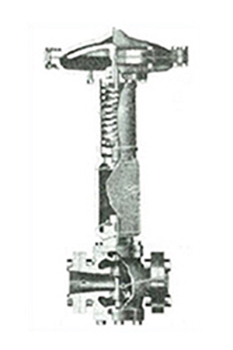
Top- and bottom-guided double-seated automatic control valve
The 6000 Series next-generation control valves
Based on 90 years of experience, the 6000 Series control valves were developed, and sales began on October 1, 2025. It is positioned as a core product for petroleum refining and chemical manufacturing markets and complies with the international standard IEC 60534*1.
The design utilizes CFD analysis*2 to improve the rated Cv value*3, and the seat leak performance complies with IEC Class IV and V. Furthermore, the structure complies with the international standard ISO 15848-1*4, which helps prevent the external leakage of process fluids.
As Azbil’s next-generation standard platform for process automation control valves, the 6000 Series will continue to meet the needs of a wide range of industries and expand its market, building on the company’s many years of experience in valve design.
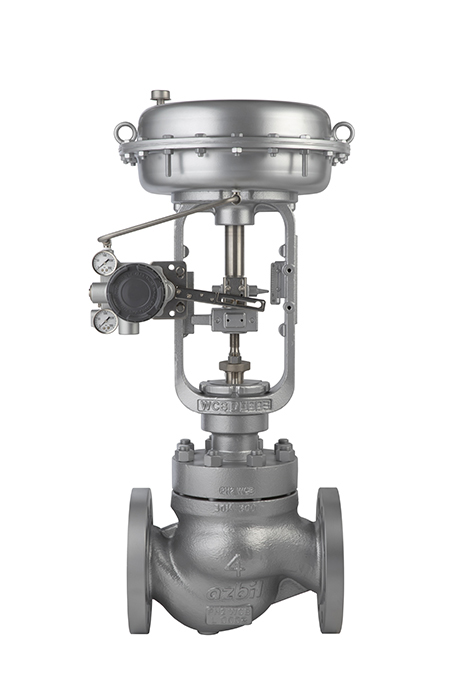
6000 Series control valve
-
*1: International standard IEC 60534
An international standard published by the International Electrotechnical Commission (IEC), IEC 60534 defines a series of standards for the design, performance, testing, noise, dimensions, and other aspects of control valves used in industrial processes. -
*2: CFD analysis
Computational Fluid Dynamics (CFD) analysis is a technology that numerically simulates the flow of fluids (liquids and gases) using a computer. -
*3: Rated Cv value
The performance index indicates how well a valve passes through a fluid. The larger the Cv value, the more easily the fluid flows, resulting in a lower pressure loss and reduced energy loss. -
*4: International standard ISO 15848-1
An international standard published by the International Organization for Standardization (ISO). It targets industrial valves and specifies methods for measuring and testing the amount of external leakage from control valves as well as procedures for certification. - This article is a translation of the Japanese version published on February 18, 2026.
 Related information