
with azbil
SPECIAL
- NEW
Special Talk | Takao Someya, Executive Director and Vice President, Director General of the Division of University Corporate Relations, and Professor at the Graduate School of Engineering, University of Tokyo × Kiyohiro Yamamoto, Director, Representative Corporate Executive, President & Group CEO, Azbil Corporation

How businesses and universities should each approach industry–academia collaboration to help bolster Japan’s competitiveness
Industry–academia collaborations are initiatives where businesses and universities work together through joint research and talent exchange to help solve challenges faced by society and business. In the medium-term management plan announced by the azbil Group in May 2025, the company has placed two concepts at the core of its management strategy: “Evolution,” meaning transforming itself by adapting to a changing environment, and “Co-creation,” meaning working collaboratively with external companies, universities, and other public, private, and academic partners to generate new value by leveraging each party’s respective strengths. When we address on-site challenges through automation while pursuing sustainable business expansion through the azbil Group’s unique business model, we position industry–academia collaboration not merely as an activity, but as a management method for tackling social issues while simultaneously achieving business growth. Professor Takao Someya leads initiatives in this regard as Director General of the Division of University Corporate Relations at the University of Tokyo. He spoke with Kiyohiro Yamamoto, Director, Representative Corporate Executive, President and Group CEO of Azbil Corporation about the approach that businesses and universities should take when acting in industry–academia collaborations.
Universities now need to collaborate with businesses and tackle social issues.
Yamamoto We have long refined our automation technology while engaging directly with our customers’ on-site needs. However, as changes in social issues and the technological environment accelerate, we are encountering more and more situations where it is difficult for the company to respond on its own. Broader perspectives and collaboration with partners are currently becoming increasingly indispensable. In this context, we would like to hear your candid thoughts on “Co-creation” with universities.
Someya
I feel that right now, everyone across Japan is being challenged to rethink how the relationship between companies and universities should evolve.
The question is how we can divide roles and create value together in order to solve social issues, while going beyond the framework of simple joint research. I would be glad if we could discuss this point among others, while also touching on the perspective of the azbil Group.
Yamamoto Professor Someya, as Executive Director and Vice President, and as a professor at the Graduate School of Engineering at the University of Tokyo, you are at the forefront of research and education. In addition, you serve as Director General of the Division of University Corporate Relations, which is responsible for supporting organizational collaboration and joint research with businesses at the University of Tokyo, as well as incubation*1 activities related to entrepreneurship. From your perspective, how do you view the current state of industry–academia collaboration?
Someya
What I frankly feel is that the significance of industry–academia collaboration has been changing considerably in recent years. Universities pursue basic research while receiving support from the state. The importance of basic research has not changed, and will not change, past, present, or future. However, in recent years, universities are increasingly being called upon to bridge the new knowledge and technologies born from basic research to the industrial world, and to reliably channel the results back into society in the form of value that addresses social issues.
Within this context, the nature of industry–academia collaboration has also been changing. Specifically, I feel that collaborations have been shifting toward format of co-creation in which businesses and universities pursue large-scale research that directly contributes to social value under shared goals such as building new industries and human resource development.
To give an example from my research in my specialist subject of organic electronics, I have been developing thin, sheet-like sensors with flexibility and stretchability, featuring multipoint and multimodal*2 characteristics resembling the properties of human skin. This is creating a new field known as “stretchable electronics.” With the cooperation of businesses, we are making progress in applying this technology in wearable devices for preventive medicine and other fields.
Yamamoto I see. With the traditional model of collaboration, universities focus on conducting basic research and publishing papers while companies focus on research outcomes alongside acquiring talented personnel, meaning each side has different objectives. In contrast to this, the new approach involves advancing your work toward a clearly defined shared exit strategy of creating social value. Naturally, since these activities are centered on collaborations aimed at exploring new business ventures rather than extensions of existing ones, it would seem that the social expectations placed on universities are also undergoing significant change.
Someya
Yes. Moreover, one of the things I would like to share as the background to this is that in the United States and other countries, there are already arguments being voiced quite strongly to suggest that universities are unnecessary. While university research and activities are highly sophisticated, universities are being confronted with the questions of whether their value and results are being sufficiently communicated to society, and whether it is necessary to inject large amounts of public funding. There is a tendency for scientific evidence to be disregarded, and for social media to exert significant influence despite having questionable accuracy. In fact, universities have produced many achievements and have served as wellsprings of innovation. On the other hand, however, debate is also emerging as to whether those achievements are broadly connected to society as a whole, or whether they are disproportionately concentrated in specific fields or segments of society.
This situation is particularly pronounced in the United States. Nevertheless, in all the universities I have visited, regardless of country, the universities themselves harbor a considerable sense of crisis regarding their own reason for existence as the entities at the center of this question.
Yamamoto In light of this context, it is becoming increasingly important for universities to generate social value through industry–academia collaboration in ways that are clear and accessible to the public.
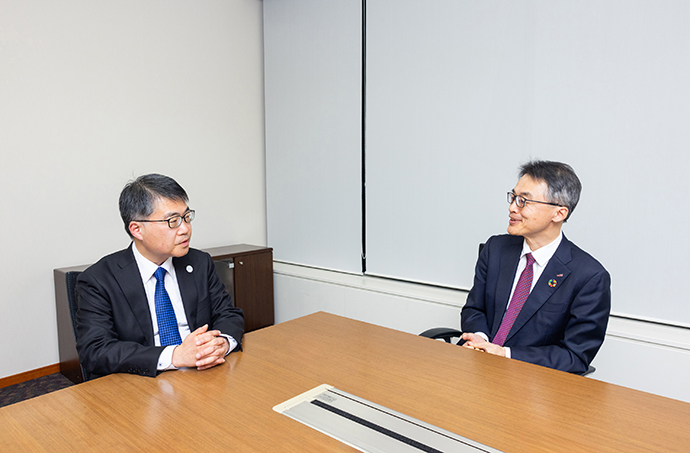
Businesses should suitably evaluate and leverage the value created through co-creation with universities.
Yamamoto
Our business is to solve challenges faced by our customers through automation technologies. In our new medium-term management plan announced for fiscal 2025, we have redefined the azbil Group’s unique business model as a cycle of customer development and foundation strengthening. This model enhances sustainability and profitability in our core businesses that are built on strong relationships with the broad and stable customer base we have cultivated over many years, while also developing new customers through our growth businesses where we seize new business opportunities in technological innovations such as semiconductors and in efforts to tackle social issues like carbon neutrality.
To further strengthen this business model, we believe it is essential not only to transform and “evolve” ourselves in order to adapt to changes in the environment, but also to “co-create” new value through collaboration with external partners such as universities and other companies; namely, to pursue open innovation.
One key characteristic of the measurement and control technologies we work with is that there is always a target that serves as a counterpart of this control, and that our fundamental premise is to directly engage with this target and create value together. In that sense, we have always worked in an environment where working together with others is the norm. We believe that by further strengthening industry–academia collaboration and combining new forms of value, we can deliver value to society more quickly and in a more meaningful way.
As social challenges grow increasingly complex, there is a limit to what a single company can do on its own to solve them. That is why we believe that collaboration with universities, namely, industry–academia collaboration, plays a particularly important role in realizing the “evolution and co-creation” set forth in our medium-term management plan. We believe that industry–academia collaboration is an important management initiative for driving corporate “evolution” of businesses from the perspectives of both human resources and technology, thereby enabling “co-creation.”
On this point, speaking from your position of advancing industry–academia collaboration projects on the university side, I would appreciate your advice on what kind of mindset companies should bring to industry–academia collaboration.
Someya
First, we would like companies to aim for joint research with a high level of commitment. Rather than viewing universities as an extension of existing businesses, we would like companies to see them as partners in creating new businesses aimed at solving the challenges they truly want to address.
What is important in this regard is not the conventional type of joint research that connects individual points together, but rather efforts where organizations mobilize their full strength to collaborate with one another. When we take on truly difficult research, even if we solve one challenge, we encounter new ones in rapid succession. We cannot tackle such research without a sustained, all-out effort.
The other key point is collaboration with startups. We believe it is important to create an environment where human resources from established companies and from startups can stimulate one another in a two-way process.
In reality, university research outcomes are often still at an early stage in terms of their completeness and evaluation for social implementation compared to the development of products and services at companies, and it is not easy to transition directly to commercialization. In recent years, the increasing complexity of social issues and the advancement of technology, has resulted in a broader zone that needs to be bridged between research and commercialization, and so the process is growing increasingly difficult. Moreover, in industry–academia collaboration, we would like companies to work together with universities in developing talent, rather than making student recruitment the primary objective. In doing so, it would be ideal if companies would take the initiative to send their top talent—the people they see as their aces—to universities. This will not only raise the quality of collaboration, but students may also find themselves drawn to these ace players, come to deeply understand the company, and perhaps ultimately be inspired to join it in the future.
Yamamoto I see. On the other hand, there is one challenge that we feel exists in industry–academia collaboration. Speaking in general terms, from a company’s perspective, the more difficult the subject matter handled, the higher the level of confidentiality, and the harder it is to keep things open.
Someya Yes, you are right. One of the most appealing aspects of industry–academia collaboration is that young students have fresh sensibilities and strong abilities, and thereby engage seriously with the challenges. It is natural that they would want to take the results of the research they worked in and publish them in academic papers. To be honest, companies that insist on keeping such results confidential become difficult partners for universities to work with. My point is that I would like companies to properly assess the potential of collaborating with universities and make the most of what universities have to offer. Of course, there is certain information that must be kept confidential for business reasons, such as customer information. However, the true aim of industry–academia collaboration should be to envision the next-generation of society and business. I believe that the next generation is, in a word, about “dreams.” Wouldn’t it be ideal for us to just talk freely about our aspirations? I believe that a company has no future if it cannot talk about its dreams.
Yamamoto I agree with your view. Azbil aspires to be a company that engages in open dialogue with universities about how society and industry should be in the future, and continues to work as a group toward making these ideas a reality.
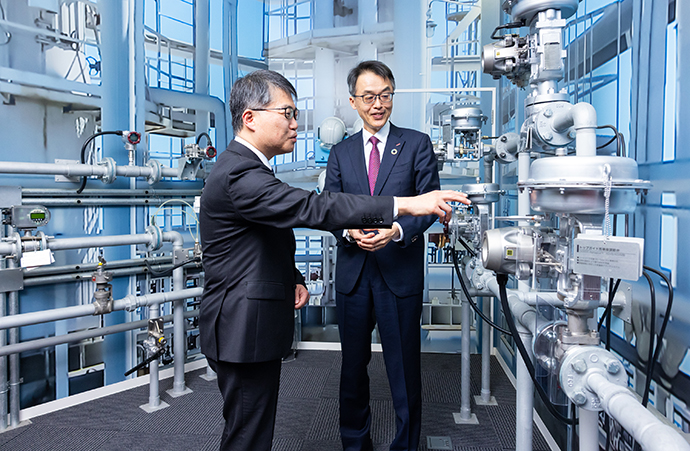
Accelerating the creation of new value through diversity-driven transformation
Yamamoto You mentioned earlier that in the United States and other countries, there has been increasingly widespread debate within society that universities are unnecessary. In Japan, however, we honestly do not hear much discussion on this topic. How does the situation actually stand in that regard?
Someya In Japan, I feel there are stronger expectations for universities to help create new industries and to develop talented human resources. We can say that, by global standards, Japan is a country where universities are highly valued by the public. Therefore, before such debates arise as they have in other countries, universities need to ensure that they fully meet the roles society wants from them. In that sense, I believe we are now in a situation where there is no time to lose.
Yamamoto If Japanese universities are able to maintain such a position, they will likely be able to continue sustaining a strong presence on the world stage. For example, they may be able to attract excellent students from all over the world.
Someya
Currently, many international students studying at Japanese universities come to Japan because they like the country. Many of them want to find employment in Japan as well.
On the other hand, however, Japanese companies are not always proactive in hiring international students, and there remain certain barriers, such as mandating that job interviews must be conducted in Japanese. At the University of Tokyo, we have significantly enhanced our programs for learning Japanese. At the same time, we believe it is important for Japanese companies to more actively recruit talent from overseas to further promote diversity. Working with people who have different perspectives drives the creation of unprecedented new value, and I believe that this in turn helps to strengthen the industrial foundation that supports our country in the future.
Yamamoto
We would like to work with the points you presented today—namely, genuine co-creation, collaboration with startups, and industry–academia collaboration focused on human resource development—and start by putting them into practice alongside the University of Tokyo while seeking the co-creation of value.
We believe that these initiatives will help attract talented individuals and will also contribute to the continued growth of our existing employees. The azbil Group aims to continue its bold efforts to balancing the resolution of social issues with business growth through industry–academia collaboration, and to contribute to society through the outcomes of these efforts.
Someya
As you mentioned at the beginning of our talk, Azbil has been delivering offerings for measurement and control as well as solutions in the field of automation. On the other hand, universities possess a wide range of core technologies related to measurement, though it is not easy for them to provide solutions that fully address customer needs.
In this sense, collaboration with companies such as Azbil is essential to appropriately match the seeds held by universities with real-world needs and thereby create social value. We have high expectations regarding the significant potential for valuable innovation through co-creation with companies like Azbil, which demonstrates a keen sensitivity to new technologies such as with the in-house development of MEMS*3 technology.
Yamamoto As a company that provides automation technologies to society, the azbil Group’s strength is in creating value on-site through the effective use of these technologies. At Azbil, we believe that it is our role to help connect cutting-edge technologies generated by universities with solutions for social issues through industry–academia collaboration, and we intend to continue playing this role.
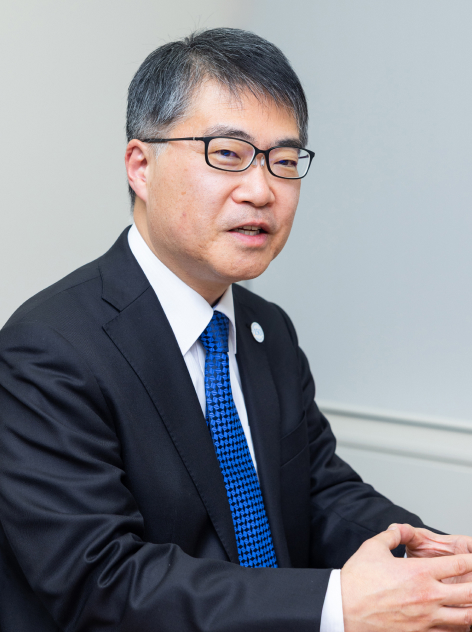
The next generation is, in a word, about “dreams.”
A company has no future if it cannot talk about its dreams.
Professor Takao Someya
Executive Director and Vice President
Director General of the Division of University Corporate Relations
Graduate School of Engineering
University of Tokyo
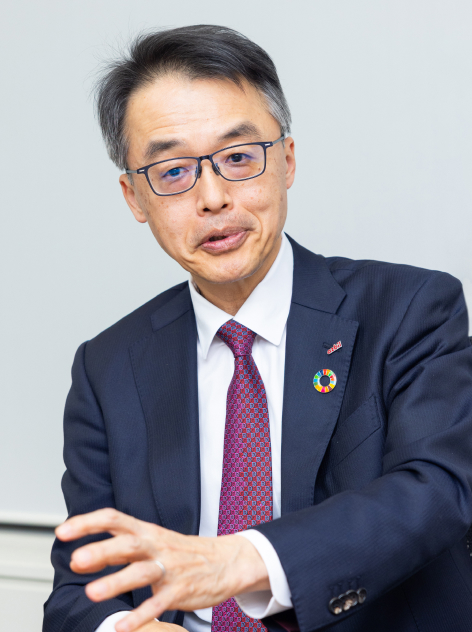
Transforming university seeds into social value through our deep understanding of customer needs
Kiyohiro Yamamoto
Director
Representative Corporate Executive, President & Group CEO
Azbil Corporation
- *1: Incubation
Activities that support and nurture new businesses and startups. At universities, this includes supporting the creation of university spin-offs based on research outcomes, providing management support in the early stages of business development, and assisting with raising funds. - *2: Multimodal
The ability to simultaneously acquire and process information of multiple different types (such as pressure, temperature, and deformation). - *3: MEMS (Micro Electro Mechanical Systems)
A wide range of devices and systems such as sensors that incorporate microscopic electrical and mechanical components on one chip.
Stretchable wearable devices are leading global efforts by a wide margin
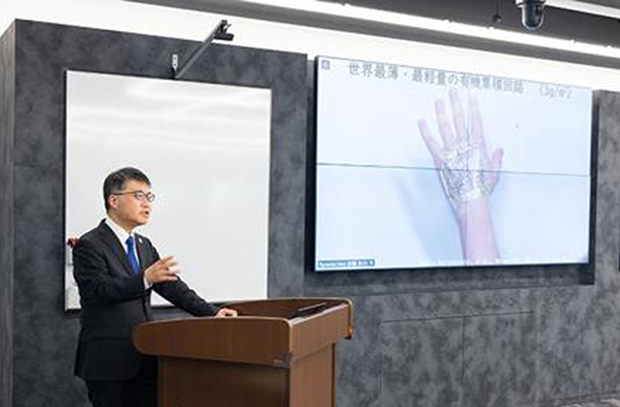
Sparked by the idea of “robot skin” with sensory capabilities, Professor Someya’s research eventually led to the successful development of a thin, sheet-like sensor that is both flexible and stretchable while also possessing skin-like multi-point and multimodal sensing properties.
Owing to these properties, the sensor can be attached to any body part, including the face, limbs, and torso, significantly expanding its range of applications as a wearable device.
This world’s thinnest and lightest electronic circuit was promoted with the catchphrase “lighter than a feather” and has been widely adopted in various applications, including the measurement of bio-data from multiple areas on the body within the field of medicine and motion capture systems in sports.

A hypoallergenic sensor (nanomesh electrode) attached to the skin
For example, if this electronic circuit is embedded in a T-shirt, patients could receive it by courier and simply wear it, enabling them to measure biometric data such as body temperature, pulse, and electrocardiograms at home without undergoing the burden of attaching medical devices. Such initiatives are increasingly being put into practical use across various fields and are beginning to create new social value.
- *This article was translated from the Japanese version of the article published on May 27, 2026.
 Related information