
with azbil
Trivia
- NEW
Gyroscope and Accelerometer

Many technologies that detect the movement of people and objects are used all around us. Examples include your smartphone screen display switching between portrait and landscape when you rotate it, pedometers recording your step count, and VR devices changing what is displayed in accordance with your head and body movements. Furthermore, these technologies are also being used in areas such as drone attitude control and game console controller operation.
These functions are made possible by gyroscopes and accelerometers. A gyroscope detects rotation and changes in direction, while an accelerometer detects linear motion. Both are sensors designed to detect motion, but they measure different things.
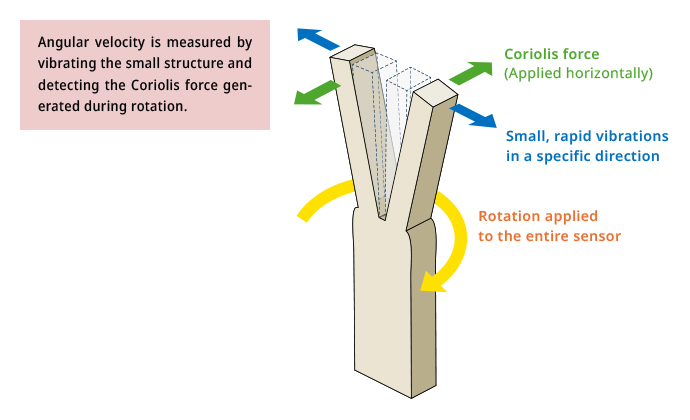
A gyroscope is a sensor that measures angular velocity, which indicates how fast an object is rotating. There are various types of gyroscopes, such as mechanical, fluid, and optical. Most MEMS*1-type gyroscopes built into smartphones are vibration gyroscopes that measure angular velocity using the Coriolis force*2.
The Coriolis force is measured using the mechanism shown in the diagram below. The small structures inside the sensor vibrate in a specific direction (blue arrow). When the sensor itself rotates (yellow arrow), a Coriolis force (green arrow) is generated laterally against the oscillating motion. The angular velocity is measured by detecting changes in this force. In actual smartphones, a three-axis gyroscope is used to accurately track the device's movement in the forward/backward, left/right, and rotational directions (changes in orientation).
An accelerometer is a sensor that measures acceleration applied to the object. Acceleration is a measure of how quickly an object's velocity changes, and gravitational acceleration can be detected even when an object is at rest.
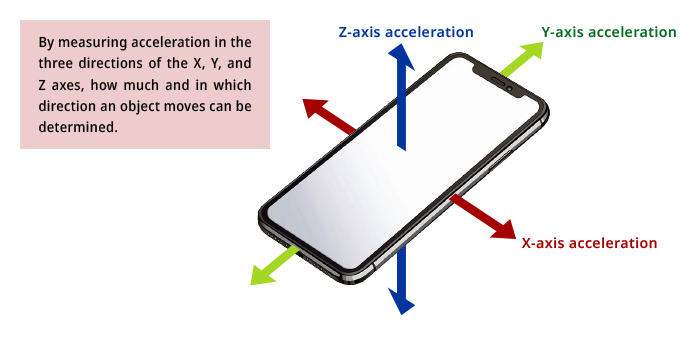
The MEMS-type accelerometers that are currently mainstream are widely used in smartphones and other devices, and they calculate acceleration by reading the displacement of very small structures as electrical signals (calculating acceleration from the magnitude of the displacement). By measuring acceleration in the X, Y, and Z axes, they can determine how much and in which direction an object moved in each linear direction.
These two sensors can be used individually, but in most cases they are used together. Gyroscopes can measure rotation with high precision but cannot detect linear motion, while accelerometers can conversely measure linear motion but cannot detect rotation. Each type of sensor has its strengths and weaknesses.
Therefore, modern electronic devices integrate data from both sources to more stably and accurately determine the attitude and movement of objects. This method is called sensor fusion*3 and is an important technology that supports our daily lives.
- *1: Microelectromechanical Systems (MEMS)
Devices or systems such as sensors that incorporate microscopic electrical and mechanical elements on one chip. - *2: Coriolis force
An apparent force that acts perpendicular to the direction of motion on an object moving within a rotating object. An example of this phenomenon is if you throw a ball straight up on a rotating merry-go-round, it will appear to curve to the side. - *3: Sensor fusion
A technology that combines data output from multiple different sensors to extract information that cannot be obtained from a single sensor.
- *This article is a translation of the Japanese version published on September 9, 2026.
 Related information