
with azbil
azbil MIND
- NEW
azbil Group internal audit: Supporting the management foundation, driving sustainable growth, and contributing to the well-being of society and employees
Internal audit aligned with international standards, grounded in a people-first philosophy and focused on achieving management goals
The azbil Group has formulated a medium-term plan aimed at achieving its long-term targets for 2030, with the goal of realizing sustainable growth and enhancing corporate value. To achieve this, it is essential not only to advance business strategies and technological development, but also to ensure that governance and risk management function effectively. Appropriate internal audits play a vital role in enabling companies to operate effectively and with control and earn the trust of diverse stakeholders. At the azbil Group, internal audit has been positioned as a foundation supporting the achievement of management objectives by connecting management and frontline operations from an independent standpoint. The Group has built a framework aligned with international internal audit standards and operates a PDCA cycle to ensure that issues identified through internal audits are reliably addressed in collaboration with administrative departments. These efforts have earned external recognition.
The role of internal audit in the global era
Since its founding in 1906, the azbil Group has built its business based on measurement and control technologies. Today, under the concept of human-centered automation, the Group aims to contribute to people’s safety, comfort, and fulfillment, as well as to the global environment. At Azbil, business activities and corporate operations are supported by complex technologies and systems, driven by advances in globalization and digital technology, as well as increasingly sophisticated regulatory and societal requirements. However, these technologies and systems only deliver true value when guided by human judgment and action. The Internal Audit Department is responsible for objectively and continuously assessing whether decision-making and business processes are functioning soundly, and whether inherent risks*1 are being appropriately managed and mitigated, and provide recommendations to drive concrete improvements.
The purpose of internal audit is not simply to detect misconduct. It involves taking an enterprise-wide perspective from an organization-wide perspective for senior management and the board and drawing on expertise in internal cotrols*2 to examine whether governance*3 and risk management are functioning effectively in support of achieving management goals.
In recent years, the risks faced by companies have become increasingly complex. The range of topics requiring management attention spans governance, risk management, information security, human rights, sustainability, and more. Against this backdrop, internal audit is now expected to demonstrate independence and objectivity, fairness and transparency, and a high level of expertise, all in accordance with international standards*4.
In the past, internal audit at the azbil Group relied in part on the individual experience and knowledge of veteran employees. Today, however, the Group is advancing the sophistication of its internal audit practices in line with international standards, with the aim of contributing to the enhancement of corporate value.
In response to the expectations of top management and the Board of Directors, and in light of changes in the social landscape, internal audit carefully examines potential risks that may emerge within governance frameworks and business processes. This is done through data analysis and interviews with personnel, while taking into account the operational conditions and specific circumstances of the business units responsible for execution. Where audit findings are identified, their root causes are explored in collaboration with the audited departments and administrative departments. These may stem from weaknesses in internal controls, differences in legal requirements or cultural contexts across countries, or sometimes in organizational culture. Rather than simply identifying issues and calling for corrective action, the key to internal audit lies in proposing practical and effective improvements tailored to each operational setting.
The Internal Audit Department comprises 24 members (as of March 2026), including five who hold the Certified Internal Auditor (CIA), an internationally recognized professional qualification. With a strong emphasis on diversity, the team is drawn from a wide range of backgrounds spanning engineering, accounting, systems, and other functions. They conduct internal audits across the entire Group, both in Japan and overseas, while also working to enhance their expertise through participation in external training programs and professional exchange forums to stay current with the latest case studies and regulatory developments.
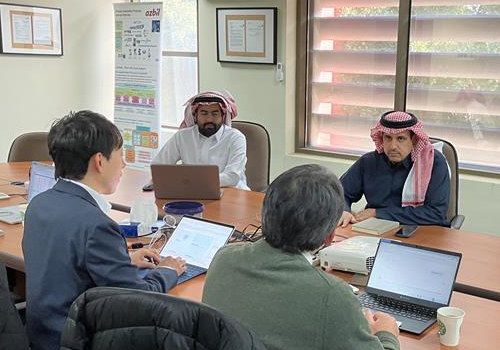
Auditors also conduct on-site audits at overseas locations.
*The photograph shows an internal audit in progress in Saudi Arabia
Building and implementing effective systems based on the PDCA cycle
In 2022, the azbil Group transitioned from a company with an audit & supervisory board*5 to a three-committee board structure. This governance structure, widely adopted in Europe and the United States, provides a highly transparent management framework in which a majority of the Board of Directors consists of independent outside directors. The Nomination Committee, Remuneration Committee, and Audit Committee are in place to create a structure that separates execution from oversight.
To ensure the effectiveness of this governance framework, the Internal Audit Department has also been organized with an emphasis on independence and objectivity in accordance with international standards. While operating as an organization reporting directly to the President, it also receives direct instructions on audit functions from the Audit Committee and reports directly to it, promoting coordinated auditing between the Audit Committee and Internal Audit.
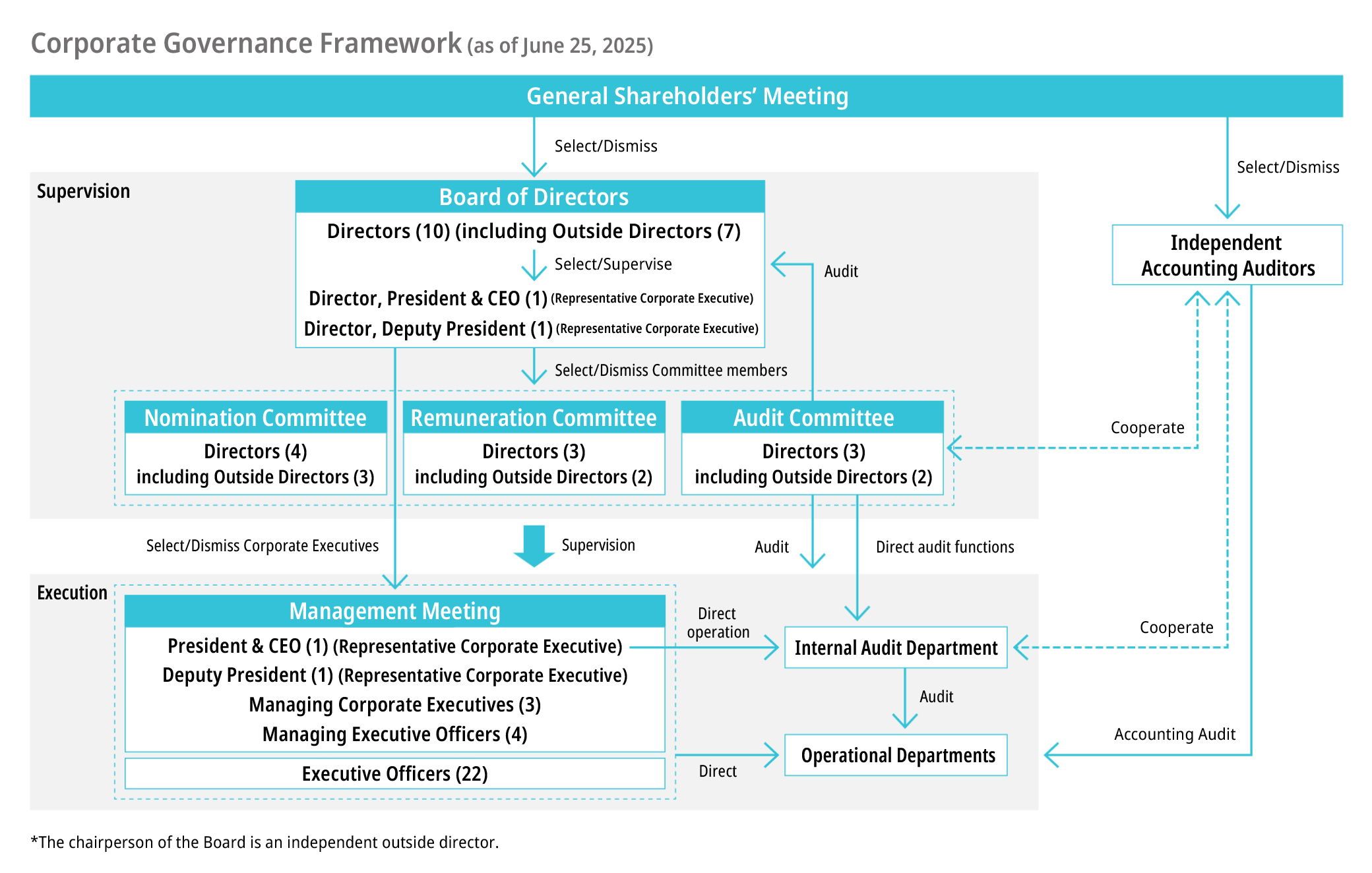
A key feature is the close sharing of information with the Audit Committee. This encompasses regular monthly reporting, as well as exchanges of views and the receipt of instructions for additional investigations.
Another distinguishing feature is that the annual internal audit plan is formulated in alignment with the Audit Committee’s audit plan.
The Internal Audit Department begins by conducting a risk assessment of the audit objectives and annual plan. Various issues arising within the company are identified and cross-referenced with considerations such as the nature of the key risks, the history of internal findings, and the potential risks going forward. Based on this analysis, annual audit objectives and plans are established.
The draft plan is refined iteratively, incorporating the views of the President and the Audit Committee, and formally decided after receiving approval from the Audit Committee and the consent of the President. Based on the annual plan thus established, internal audits are conducted on a business site basis within Japan and on an overseas affiliate basis in other countries.
The scope of internal audits is broad, covering not only the appropriateness of various business processes but also risk-related matters such as information security, the business continuity plan (BCP), and compliance.
However, the internal audit plan is not fixed. Should new risks emerge during the course of the year, part of the plan is revised, and audits are conducted in the higher-priority areas. In addition, when the President or the Audit Committee issues instructions to audit or investigate new risks amid rapidly changing business conditions, risk assessments are carried out on a case-by-case basis, and emergency audits are conducted as necessary.
When issues that could constitute high-risk factors are identified during the audit process, prompt corrective action is requested to the relevant site where improvements can be made locally. Where issues require a company-wide response, the Internal Audit Department works in collaboration with administrative departments such as general affairs, human resources, and legal to provide guidance on improvements and to ensure thorough organization-wide communication. Following up on the status of corrective actions after such requests have been made is also an important role of the Internal Audit Department.
All audit findings and the status of responses are submitted as written reports to the President and the Audit Committee, shared with management, and utilized for future improvements and actions.
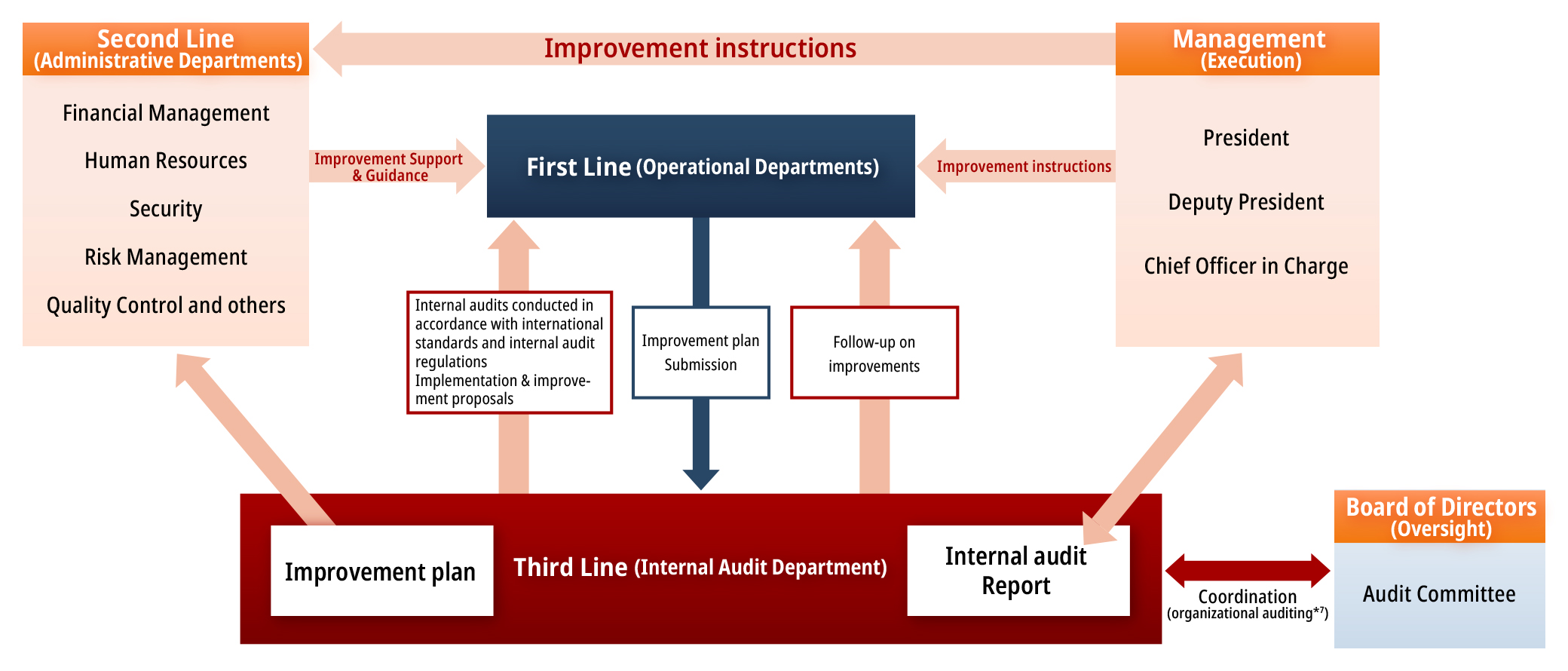
In this way, a PDCA cycle encompassing planning, execution, review, correction, and reporting functions effectively, enabling the achievement of management objectives and the advancement of risk management. These efforts are conducted through the three lines model*6, in which operational departments, administrative departments, and the Internal Audit Department serve as the first, second, and third lines, respectively. The Internal Audit Department takes an organization-wide view as the third line and drives improvements in collaboration with both operational and administrative departments, thereby building a highly effective risk management framework.
Digital transformation is an indispensable tool in supporting internal audit activities, and the use of generative AI has begun in audits. Tasks that once required manually reviewing vast volumes of documents to conduct analysis and identify issues have been streamlined, enabling more comprehensive and multi-faceted information gathering. As a result, it is now possible not only to reduce the time required, but also to enhance audit precision by going deeper into analytical content to uncover the root sources of risk. Further benefits are emerging across a range of applications, including discussions and deliberations informed by generative AI perspectives, and the refinement of audit reports.
As one measure to detect misconduct and prevent risks before they materialize, a reporting and consultation desk has been established within the Internal Audit Department, accessible to all Group employees and stakeholders. As this desk is operated within an independent department, employees can use it without concern of potential disadvantage resulting from making a report. The desk accepts a wide range of matters beyond legal violations and human rights issues to include personal concerns and contributes to creating a work environment in which employees can work with peace of mind. At the same time, new risks identified from reports and consultations are appropriately shared with the Internal Audit Department for follow-up audits and verification. Another characteristic of the azbil Group is that the company as a whole works in an integrated manner to strengthen internal controls with internal audits conducted by the Internal Audit Department at the center of these efforts.
The perspectives of those involved in audits
Operational departments, administrative departments, and the Internal Audit Department work in coordination, continuously operating the PDCA cycle while translating audit findings into improvements, and appropriately disclosing these efforts to stakeholders. The Internal Audit Department of the azbil Group has earned recognition from external parties in this regard. In the survey results on disclosure of internal audit status (2025) announced by the Institute of Internal Auditors Japan at the 58th National Conference for the Promotion of Internal Auditing, the information disclosure in Azbil Corporation’s securities report was highlighted as a best practice example. In addition, the Group’s effective response to the revised Global Internal Audit Standards, which came into effect in January 2025, has been introduced in a course at The Open University of Japan (“Modern Internal Auditing: The Global Internal Audit Standards and Their Overview”).
Behind this external recognition lies an approach of confronting issues and risks through audit and to working together with employees to drive improvements.
Internal audit is not limited to reviewing past documents and evidence. It is an activity that identifies issues and supports improvements to help the organization move toward a better state. It involves the company and its employees working together to address issues and risks and linking this to improvements and prevention in order to build a better future. The azbil Group aims for a “future-oriented internal audit” that goes beyond a simple checking function, dispels the perception that audits findings are something to be avoided, and supports the growth of both the company and its employees while strengthening the management foundation.
Based on this philosophy, the azbil Group continues to advance reforms aimed at enhancing its internal audits. While reinforcing the foundations of internal audit — independence, objectivity, ethical conduct, and fairness — the Group is actively incorporating new methods and skills such as data-driven auditing and generative AI to raise audit quality.
To ensure that these initiatives function effectively in practice, the Group places importance on maintaining a consistent approach in audit operations. To avoid misjudging risks due to excessive adherence to internal logic or organizational values, audits are conducted with a broad and diverse perspective and flexible thinking. The audit team listens carefully to the views of employees in audited departments, and when issues are identified, works together to explore their causes rather than making one-sided findings. In this way, the Group values a sincere approach that supports improvements in a collaborative manner.
The azbil Group has always placed people at the heart of its business. That philosophy is consistently reflected in how internal audit is conducted. Through internal audits that combine the rigor of international standards with an attentive, people-first approach, the Group will continue to pursue the well-being of society and employees and the further enhancement of corporate value, supported by the trust of customers and stakeholders.
- *1: Inherent risk
This refers to risks inherent in the business activities themselves as well as risks existing without any control measures being taken. - *2: Internal control
This refers to the business processes, regulations, rules, and supervisory systems a company establishes and operates to achieve its management objectives. Unlike internal audits, internal controls are subject to audits. - *3: Governance
This refers to the oversight and decision-making mechanisms in corporate management as well as the systems in place to ensure transparency, legality, and effectiveness in management. - *4: International standards
This refers to the Global Internal Audit Standards published by the Institute of Internal Auditors (IIA). This is an internationally recognized standard of professional practice for internal auditing that was officially implemented in January 2025. - *5: A company with an audit & supervisory board or a company with a three-committee board structure
This refers to the typical corporate governance structures defined in Japanese Companies Act. A company with an audit & supervisory board is a traditional form of governance where the board of auditors supervises the execution of duties by the directors, while a company with a three-committee board structure is a form of governance that establishes a nominating committee, a compensation committee, and an audit committee. - *6: Three lines model
The Audit Committee works closely with the Internal Audit Department. By giving instructions to the Internal Audit Department and receiving its reports, the Audit Committee gathers the information it needs and checks whether the company's internal control system is working properly and effectively. (Based on the Corporate Governance System (CGS) Guidelines issued by Japan's Ministry of Economy, Trade and Industry.) - *7: Organizational auditing
This is a comprehensive audit methodology implemented by the internal audit department in collaboration with the audit committee, management departments, and other relevant departments, based on the company's overall internal control system. - *This article is a translation of the Japanese version published on March 26, 2026.
 Related information