
with azbil
SPECIAL
Special Talk | Dr. Takashi Usuda, Senior Executive Officer of the National Institute of Advanced Industrial Science and Technology (AIST) and Director of AIST's National Metrology Institute of Japan (NMIJ), & Hideaki Ishii, Managing Corporate Executive in charge of research and development at Azbil Corporation
Fulfilling clients' measurement quality needs
by providing products and services that conform to measurement standards
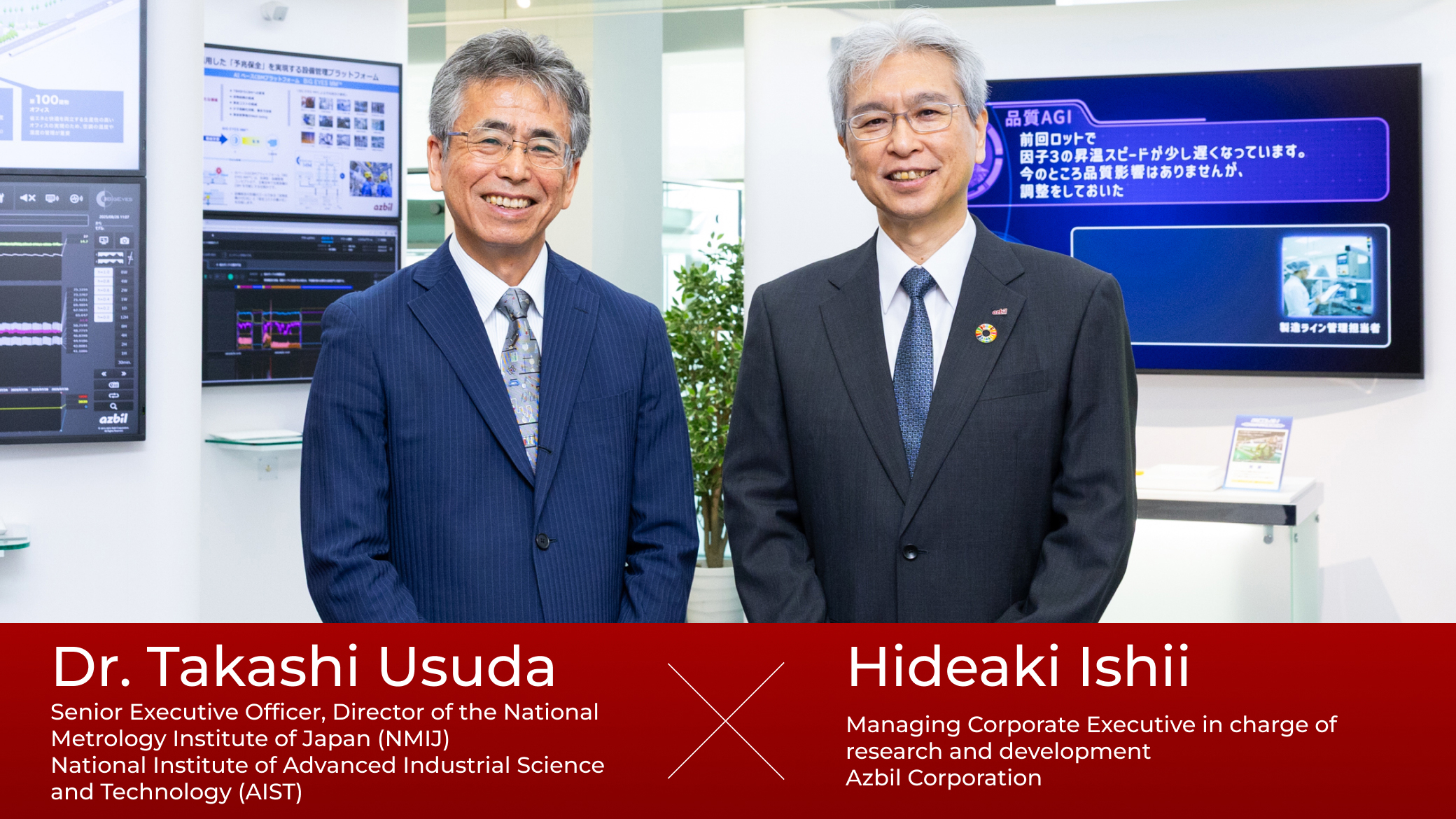
In October 1996, Azbil Corporation established the Measurement Standards Center (now the Measurement Standards Section) in the Fujisawa Plant (now the Fujisawa Technology Center) in Fujisawa City, Kanagawa Prefecture, Japan. From the start of the Measurement Standards Section to the present day, it has been the National Metrology Institute of Japan (NMIJ) of the National Institute of Advanced Industrial Science and Technology (AIST) that has supported the development of the azbil Group's measurement standards, by giving appropriate advice. The aim of NMIJ is to establish national metrology standards and provide them to society. On this occasion, Takashi Usuda, who leads the field of metrology standards in Japan as the Director of NMIJ, & Hideaki Ishii, Managing Corporate Executive in charge of research and development at Azbil Corporation, talked with each other about the past, present and future of measurement standards.
Correct measurement maintains trust in society and manufacturing
Ishii
Mr. Usuda, you have led the field of metrology standards in Japan for many years now. We have received guidance and support from the National Metrology Institute of Japan (NMIJ) headed by Mr. Usuda since the time the foundations of Azbil's Measurement Standards Section were being created. That relationship has lasted for over thirty years now.
Measurement standards are essential to manufacturing. Meanwhile, generally, their importance is quite hard to convey. Therefore, today, while hearing your thoughts on the role of measurement standards, their connection with Azbil Corporation, and their future, I'd like to once again delve deeper into their significance.
Usuda National metrology standards are a "cornerstone" that give reliability to the act of "measurement" and its results. Measurements are indispensable in all social activities, including people's daily lives, industry, science, and economics. No matter how accurately you try to measure, if the "cornerstone" is not correct, the measurement is meaningless. Trust in and transparency of national metrology standards support the foundations of society, and without them, the value of technology and business transactions itself is undermined.
Ishii It is just as you say. The reliability of national metrology standards is one of the foundations of society as a whole, and at the same time, measurements are also essential to our business activities. In product development, it is necessary to clearly show that measurement standards have been established. If standards are uncertain, a fault or trouble may arise when the customer uses the product, and depending on the situation, that could lead to a complaint. When that happens, the customer is sure to ask "What standards have you been using with this product?" So, I think it is important to have standards that form the basis of measurement firmly entrenched in the company, and to base product excellence on them.
Starting with the Convention of the Meter 150 years ago, efforts to formulate international measurement standards proceed
Usuda
It is said that the first person in history to attempt to standardize measurement units for length, weight and so on across different territories was Shi Huangdi, the first emperor of the Qin dynasty of ancient China. Then, in eighteenth-century Europe the economic activities of the middle classes started to flourish and the natural sciences also developed greatly, so movements to decide on scientifically universal units spread. It was in that context that the metric system was created in France.
The metric system defined the unit of length that is the meter (m) and the unit of mass that is the kilogram (kg). At first, based on the length of a meridian and the mass of a certain volume of water, metallic artifacts were made.
At the time, standardization of units was an important issue in countries other than France too. At the 1867 Paris World's Fair, scientists formed a committee for the international standardization of units using the metric system. As well, in 1875, representatives of 17 countries entered into "the Convention of the Meter" whose aim was for various countries to cooperate and introduce the metric system. 1889 saw the creation of the "international prototype meter" and the "international prototype kilogram", of which there were only one each in the world. Japan, which had entered into the Convention of the Meter in 1885, also received a copy of each one of these international prototypes.
After that, the definitions were revised in line with the progress of science, and in 1983, a new definition of the meter that was based on the speed of light was created. Further, in 2019, a new definition of the kilogram that is based on the Planck constant, which is a physical constant, was introduced. This meant a more accurate standard that replaced the international prototype was realized.
Ishii When it comes to units such as that of length and mass that are defined by the metric system, their equivalence in measurements is guaranteed by international standards, so each country can "measure correctly" based on the shared standards. NMIJ carries out the role of guaranteeing Japan's "national metrology standards" based on precisely these international standards, doesn't it?
Usuda
Yes, that's right. What is important is that the international system of units and national metrology standards be connected with measurement instruments used in all industrial scenes. For as measuring instruments are used over long periods of time, aging that manifests in loss of accuracy and so on cannot be avoided. So, it is vital to compare the performance of measurement instruments with more stable reference instruments, called "reference standard instruments", at set intervals, and adjust the measurement instruments - that is, calibrate them - if necessary.
At our Institute, we manage Japan's highest-ranked standards (national metrology standards), and globally guarantee their accuracy. Various businesses have measurement instruments for measuring pressure, temperature, humidity, electricity, and so on. The instruments at each business that are the "reference standard instruments", thought to be the most accurate instruments, are calibrated using the national metrology standards managed by our Institute. Through this, their accuracy is maintained. Further, by calibrating measurement instruments in the field based on the reference standard instruments that each business owns, ultimately, the "metrological traceability*1" that connects the national metrology standards with measuring instruments in the field is maintained.
Regarding the accuracy of the national metrology standards managed at each country's metrology institute, transfer standard instruments (special reference standard instruments with excellent stability) are passed around, and equivalence is checked using intercomparison. Based on these results, a system in which calibration certificates issued using national metrology standards at national metrology institutions are mutually recognized (international MRA: Mutual Recognition Arrangement) is used to guarantee the equivalence of the national standards worldwide.
The start of the Measurement Standards Center is strongly supported by NMIJ
Usuda At Azbil Corporation, you have set up a special section for maintaining the traceability of measurement results back to national metrology standards through calibrations of each kind of measuring instrument, haven't you?
Ishii
Yes. In October 1996, the company set up the Measurement Standards Center. At Azbil Corporation, measurement and control are its core businesses. In particular, you could say measurement instruments are the foundation which supports its philosophy of "human-centered automation". A factor behind the setup of the Measurement Standards Center was that in 1993 the revised Measurement Act was put in force, and the number of customer requests concerning the accuracy of measurement instruments increased rapidly. In order to respond to those requests, the company started to prepare for the setup.
When the Measurement Standards Center was set up, the person in charge visited the NMIJ of AIST, and when they asked for support, everyone at the NMIJ gave them a lot of useful advice based on the wide experience and know-how that they had cultivated over many years. At the time, Azbil Corporation did not have sufficient knowledge concerning measurement standards, but the people at the NMIJ patiently accepted the situation. When I think about it now, I am deeply grateful. If the company had not had the support of everyone, it would not have been able to bring to reality the current Measurement Standards Section, which enjoys the high regard of not only its customers but also its competitors.
Usuda After all, the field of measurement standards is usually one of hard and steady activities that don't attract lots of attention. It's more of a force behind the scenes. At the time, overseas expansion of Japanese businesses was becoming increasingly frequent. Meanwhile, the Product Liability Act ("PL Act") was put in force in 1995. As a result, at that time, the interest of Japanese businesses in measurement standards was beginning to heighten. Against this backdrop, Azbil Corporation recognized the importance of measurement standards quickly and came to us for advice, and I was really happy about that. I actually heard that the person in charge at our Institute also cooperated positively.
Relocation to a newly established building leads to the realization of the ideal environment for calibration
Ishii
Thanks to you all at the Institute, since then, the company has consistently performed calibration of measurement instruments used by the company and the group companies, as well as by the customers. In the process, we have also focused on registration with the Measurement Act traceability system (JCSS: Japan Calibration Service System). This is a Japanese calibration business registration system based on the Measurement Act, and it certifies that you have calibration competency that conforms to ISO/IEC 17025 (an international standard concerning the technical competency of calibration organizations).
To date, we have registered as a JCSS calibration business in six categories, beginning with pressure, and including temperature, humidity, electricity (direct current, low frequency), flow rate / flow speed, and time, frequency, and rotational speed. In addition, we have obtained high evaluations for technology concerning thirteen kinds of calibration services that use measurement instruments, and today Azbil Corporation is widely recognized as being a top-class calibration service provider in Japan.
Usuda At Azbil Corporation, after starting the Measurement Standards Center, you gradually widened your efforts, including increasing the number of your JCSS registration categories and increasing the scale of your facilities and equipment, didn't you?
Ishii
Originally, the calibration laboratory of the workplace where calibration of measurement instruments was carried out was set up in Building 30 in the Fujisawa Plant when the Measurement Standards Center was launched. However, that building was a regular office building, and although we implemented various measures for conducting measurements, as a place for carrying out calibration that required accuracy, the place had fundamental problems from an environmental perspective.
For example, the risk of flood damage. Close to the Fujisawa Technology Center runs the Kashiogawa River, which is designated a second-class river (important water system) in Japan. There is concern about the risk of flooding from heavy rain, typhoons and so on. The calibration laboratory, which needs to be a place where measurements are not affected by vibrations, cannot be set up on the upper levels of the building, so inevitably, it must be set up on the first floor of the building. Therefore, concern about inundation from the river flooding cannot be erased. Also, the Tokaido train line runs nearby, and it is also hard work to reduce the impact of vibrations and the like from when trains are passing by.
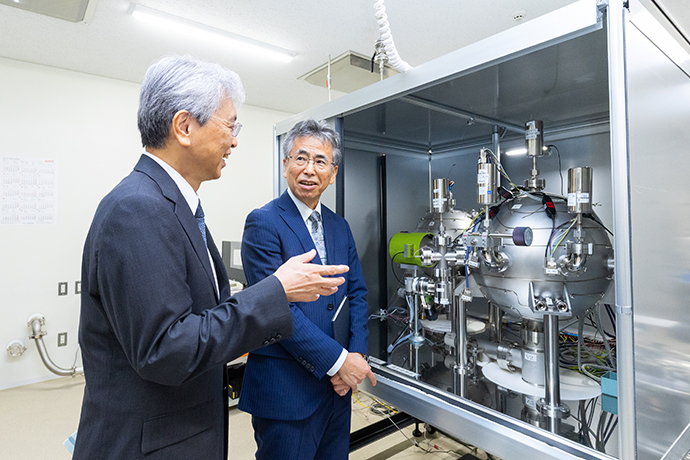
In response to these issues, the company has set up a backup facility at the Kawara Technology Center in Fukuoka Prefecture, so the company has set up a system which allows it to provide a minimum level of calibration services if by any chance the calibration laboratory in the Fujisawa Technology Center becomes unable to operate. Further, we have decided to move the calibration environment to the new laboratory building (Building 104) which started operation in the Fujisawa Technology Center in September 2022.
Building 104 was built in a place that is about 1.4 meters higher than that of Building 30, so we have been able to greatly reduce the risk of inundation from the river flooding. As measures against vibrations, we have structurally separated the foundation of the calibration laboratory from that of Building 104 itself, making it difficult for ground vibrations to be transmitted to the laboratory.
Thus, the company is proceeding with efforts to increase the quality of its products and services; for example, by providing sustainable and optimum environments for calibration.
The world of measurement standards launches into outer space
Ishii This year marks 150 years since the Convention of the Meter was concluded by 17 countries in 1875. I heard that on World Metrology Day on May 20th, 2025, a commemorative ceremony was held in Paris, France, and lectures and panel discussions were held on the themes of the International System of Units and metrology. I heard that you also took part in the event. Was there anything especially memorable about it for you?
Usuda
What I found most memorable was the discussion about time. Presently, Coordinated Universal Time (UTC) is determined by precise atomic clocks. It is equivalent to time at the line of 0° longitude; that is, at the prime meridian. If we calculate time difference, we can determine what time it is anywhere on earth. This is called the time scale, and now we are trying to extend that concept to outer space.
According to the theory of relativity, the progression of time changes depending on the strength of gravity. Clocks in places with strong gravitational influence run more slowly, while clocks in places with weak gravitational influence run faster. For example, the moon has about one sixth of the gravity of the Earth, and Mars has about one third the gravity of Earth, so clocks on the face of the moon and Mars run faster than those on Earth. When communicating between the moon, Mars, and the Earth, it is necessary to be conscious of not only the differences in the time it takes for radio waves to reach places, but also the differences in the pace of the progression of time between those places. So, how to synchronize with the Earth's time scale becomes a major issue.
As the sphere of human activities expands into space, it is essential to consider methods that allow us to share standards such as time. It's possible that in the future, human beings will create communities on the moon and Mars, and carry out various industrial activities and economic activities. As we look towards such a future, research concerning how to understand the metrology standard that we call time is already proceeding in the European scientific community, and I was strongly impressed by the breadth of academia involved in this as well.
Ishii
I see. The world of measurement standards will expand to outer space as well, won't it? I would also like us here at Azbil Corporation to be able to take on the challenge of creating a pleasant space in the International Space Station in the future too. After turning my thoughts to future business which will likely come, firstly, concentrating on the present situation, it is important to consistently provide value to facilities such as buildings and plants which will operate over a long period of time. Actually, it is not rare for the life cycle of such facilities to extend to a period of 30 years. In order to respond to problems which occur, we would like to continue to strengthen our business, in which we seek to acquire and keep clients long-term in order to build a stable income.
At the same time, an important mission of Azbil Corporation is to keep its eyes on social issues to find growth areas, and create new areas of automation. If new measurement needs are revealed in such growth areas, of course we will actively seek to respond to them. We are also thinking of becoming a registered business operator in other JCSS categories which we are currently not registered in, if it is necessary.
Further, to support our efforts, it is vital to train personnel to have a thorough knowledge of measuring standards. In order to strengthen knowledge in not just the Measurement Standards Section but also departments such as product development, quality assurance, and manufacturing, currently we are providing educational programs and running in-house training on measurement standards. This education and training is aimed at various levels of personnel, from new employees to beginner, intermediate and advanced-level personnel.
Here at Azbil Corporation, we hope to continue to receive the cooperation of NMIJ of AIST in our various endeavors, and to further develop the field of measurement in Japan's industrial world. We appreciate your continued support.
Usuda In the recent tough business environment, with its human resource shortages and higher costs, quality control tends to be sidetracked. The fact that Azbil Corporation has set up a Measurement Standards Section in these conditions shows that you have definite confidence toward quality and strong competitiveness, and I think that you are a very reassuring presence to us too. We also look forward to continuing our good relationship with you.
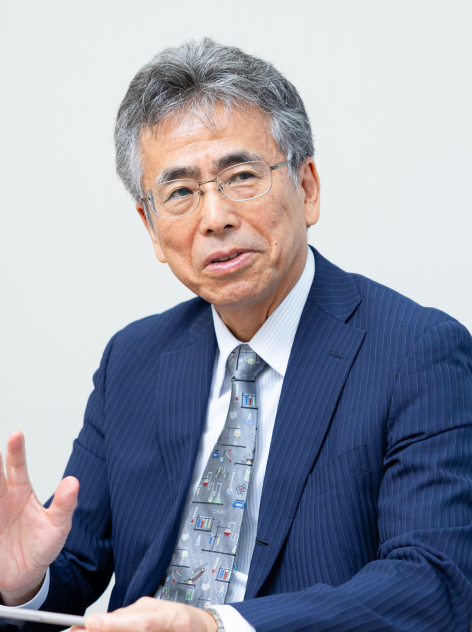
Using calibrations based on national metrology standards to guarantee globally recognized accuracy
Dr. Takashi Usuda
Senior Executive Officer, Director of the National Metrology Institute of Japan (NMIJ)
National Institute of Advanced Industrial Science and Technology (AIST)
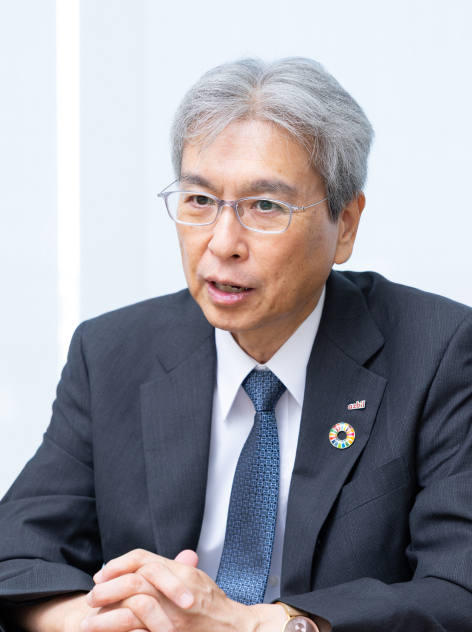
Measurement standards that bring peace of mind and trust to measuring are indispensable to the development of the economy and society
Hideaki Ishii
Managing Corporate Executive in charge of research and development
Azbil Corporation
- *1: Metrological traceability
The ability to trace a chain of calibrations back to ultimately connect a measurement with a national or international standard. - *This article was translated from the Japanese version of the article published on January 21, 2026.
 Related information