
Biodiversity Conservation
In agreement with the “Declaration of Biodiversity by Keidanren and Action Policy,” and based on our corporate philosophy of “human-centered automation,” Azbil is working worldwide to develop sustainable management strategies, with the goal of realizing a sustainable society, using the SDGs as a new set of guideposts. Specifically, to bring about a society that is in harmony with nature, we will maintain a nature-positive approach and are continuing to support biodiversity preservation through our business, to promote improvements in our supply chain involving our business partners, and to work in collaboration with various partners to further protect the natural environment.
Environmental conservation activities (in cooperation with local partners)
In cooperation with NPOs, universities, and local governments, the azbil Group is helping to preserve nature in local areas where azbil Group bases are located, such as Fujisawa City in Kanagawa Prefecture, or Minamiaizu Town in Fukushima Prefecture, as well as our own premises in Kyotamba Town, Kyoto Prefecture.
Number of Activities Held and Participants
Protecting the Maiden Lily in Minamiaizu
Azbil signed an agreement with Minamiaizu Town in Fukushima Prefecture in July 2011 regarding environmental conservation activities, and has been working on environmental conservation activities in cooperation with the local community. Minamiaizu Town is known as a habitat for the Himesayuri lily, which is designated as a near-threatened species on the Ministry of the Environment's Red List.
The azbil Group is engaged in activities to protect the Himesayuri lily, such as installing electric fences and weed control sheets and maintaining wooden walkways, as well as activities to increase the Himesayuri lily population by planting seeds. It takes many years for the Himesayuri lily to bloom, but our efforts so far have led to tangible results, such as confirming flowering in the areas where we planted the seeds.
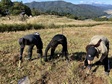
Planting seeds

Himesayuri
(a near-threatened lily species)
Greenery Preservation in Fujisawa
The Fujisawa Technology Center, the largest facility of the azbil Group, signed an agreement with Fujisawa City in January 2011 regarding green space conservation activities. We are conducting environmental conservation activities in green spaces within the city.
In this initiative, the azbil Group employees, under the guidance of the NPO Fujisawa Green Staff Association, are engaged in green space conservation activities at Nishitomi Second Green Space, including tree felling and undergrowth clearing.
In addition, at Obauramon Park, we are carrying out maintenance activities such as mowing the grass around the nesting sites near the retention pond where wild birds gather, in order to protect the habitat of the kingfisher, the official bird of Fujisawa City.

Green space conservation
activities

Kingfisher,
the official bird of Fujisawa City
Azbil Kyoto Forest Initiative
Initiative in Azbil Kyoto Forest
The factory began operations in 1996 as Azbil Kyoto, and since then, the forests surrounding the factory have grown along with the surrounding mountains and woodlands.
Since 2013, we have been working with external expert organizations such as universities and NPOs to engage in environmental education and awareness-raising activities related to natural environment conservation through forest surveys, tree planting, and forest maintenance in which the azbil Group employees participate.
Certification as a site for coexistence with nature
These ongoing activities were recognized, and in September 2025, Azbil Kyoto Forest was designated as a Nationally Certified Sustainably Managed Natural Sites by the Japanese Ministry of the Environment. In the certification process, two values of biodiversity were evaluated: “rural landscapes and mountainous areas” and “ecosystem services.”
We will continue our natural environment conservation activities in cooperation with the local community, maintaining the value of this site as a place for coexistence with nature, and contributing to the realization of nature positivity.
For information on our activities in Azbil Kyoto Forest and the state of biodiversity, please refer to the Biodiversity Visualization Map (Japanese only) operated by the Ministry of the Environment.
the Biodiversity Visualization Map
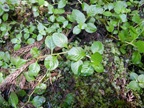
Mizuyukinoshita (Ludwigia avalis)
(Kyoto Prefecture Red Data Book: Species of Note)
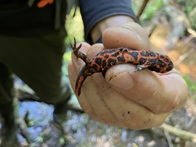
Japanese fire-bellied newt
(near-threatened species)
Solving environmental problems through our business (examples of biodiversity conservation)
Contributing to marine ecosystem conservation
We provide solutions for ballast water treatment systems, which are required by the Ballast Water※Management Convention for large vessels, utilizing knowledge and know-how cultivated in the ship business, and products conforming to ship certification.
※Seawater is loaded into the bottom of large vessels to stabilize the hull when there is no cargo. Ballast water is considered to be a cause of invasive species dispersal because it contains marine life like zooplankton, phytoplankton, seaweed fragments, etc., which are released along with the water.
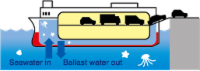
Ballast water illustration
Developing biodiversity initiatives for business partners (improving our supply chain)
The azbil Group publishes the “azbil Group Sustainable Procurement Guidelines” to its business partners. We explain the concept of biodiversity conservation, the relationship between business activities and biodiversity, and give examples of possible initiatives.
Sustainability
- azbil Group’s Sustainability
-
Environment
- Environmental Policy and Management
- Disclosure aligned with the TCFD and TNFD recommendations
- Efforts to Combat Climate Change
- Initiatives for Resource Circulation
- Biodiversity Conservation
- Water Resource Initiatives
- Chemical Substance Management and Pollution Prevention
- Products and Services Designed for Sustainability
- Social
- Governance
- Social Contribution
- Sustainability-related References
- azbil Group CSR Hotline
- Contact us
- Sitemap